Steam Wishlist Conversion Rate — Real Benchmarks for Indie Launches
Last updated: 2026-09-08 · Reading time: 7 min
For an indie Steam launch in 2026, expect 10-25% wishlist-to-purchase conversion in launch week and 20-40% lifetime. The rate varies more than founders expect, by genre, price, and wishlist source, and Steam’s built-in UTM dashboard makes paid-campaign performance look ~75% worse than reality.
Page conversion is not wishlist conversion. This guide is the launch-side funnel: wishlist → sale, measured against the wishlists you already earned. If you are after capsule click-through rate or the visit → wishlist rate on your store page — the pre-launch funnel, whose denominator is store-page visitors rather than wishlists — that is a different number with different fixes, and it has its own guide: Steam page conversion rate.
Launch-week conversion benchmarks (by genre)
These are wishlist-to-purchase rates measured in the first 7 days post-launch. Source: 77K-app Steam calibration corpus + public revenue disclosures. To estimate what any released comp actually grossed from its review count, use the Steam revenue calculator, or turn your own wishlist count into a launch-week sales range with the Steam wishlist calculator.
| Genre cluster | Launch-week conversion | Why |
|---|---|---|
| Strategy / 4X / Tactics | 15-25% | Engaged niche; long evaluation cycles before wishlist add |
| Roguelike / Roguelite | 12-22% | High word-of-mouth pulls in late buyers |
| Simulation / Management | 14-22% | Premium price; commitment-heavy buyers |
| Visual Novel / Story | 10-18% | Heavy late-tail (sales) conversion |
| Action / Platformer | 8-15% | Crowded segment; demos drive wishlists from non-buyers |
| Horror / Survival | 10-20% | Streamer-driven spike at launch |
| Free-to-play-adjacent | 5-12% | Buyer pool dilutes when free alternatives exist |
Ranges represent the P25-P75 band, not the full distribution. Your specific game may fall outside.
Sliced by wishlist tier instead of genre, the pattern from How To Market A Game’s developer-survey benchmarks points the same direction, and adds a wrinkle: bigger wishlist bases convert a larger share in launch week.
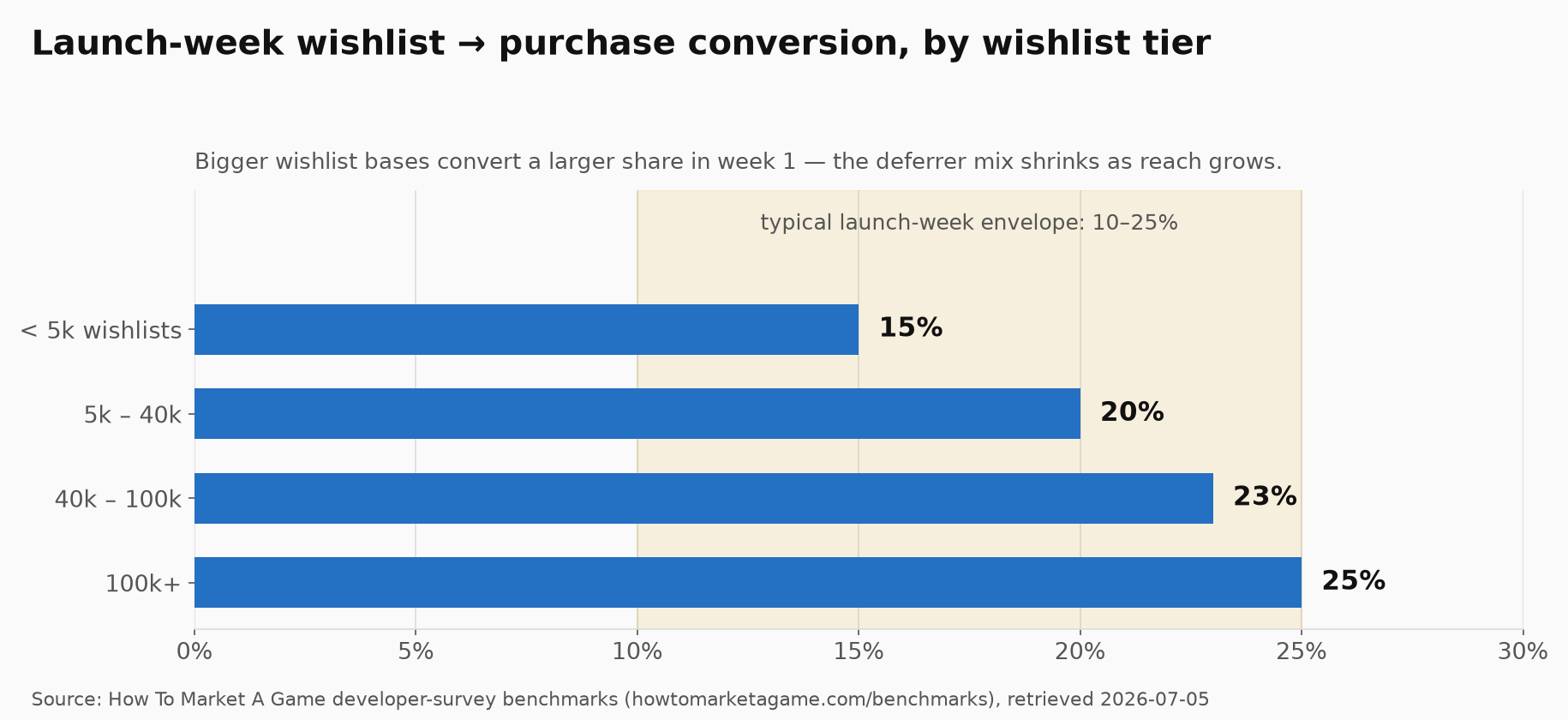
Everything on this page is the launch-side funnel: what happens to wishlists you already earned — the pre-launch visit → wishlist funnel is a separate guide, linked at the top. And these benchmarks are the measurement; for the tactics that move your position within them (the launch-discount decision, the day-3 Discovery Queue hinge, and Steam’s wishlist-email machinery), see how to convert Steam wishlists.
What actually moves the conversion rate
1. Wishlist source (the largest single factor)
Organic-Steam-discovery wishlists convert 2-4x better than paid-campaign wishlists. Someone who finds you on the Steam algorithm is already in buying mode; someone clicking through from a TikTok ad is mid-scroll. The Boxleiter $5/wishlist rule averages across both, which is why ad-heavy launches under-perform expectation. For the full dollar decomposition by source, price, and region, see what a Steam wishlist is worth.
2. Price point
Under $10 → conversion in absolute terms is highest, but per-unit revenue compresses. $15-25 → the indie sweet spot for most genres. $30+ → conversion drops noticeably, but lifetime tail revenue (sales, regional pricing) is stronger. The Boxleiter multiplier moves with this.
3. Wishlist trajectory shape
A wishlist count that grows linearly across the dev cycle converts better than one that spikes around demos. Spike-driven wishlists tend to include more "I’ll wait for sale" buyers; linear-growth wishlists are dominated by genuinely interested players. The shape matters as much as the magnitude; the Steam Next Fest wishlist spike is the canonical example, pulling in low-intent “tourist” adds that convert below baseline.
4. Region mix
US/EU wishlists convert at higher absolute prices; CIS/SEA wishlists convert at much lower regional prices. A wishlist count weighted heavily toward CIS/SEA delivers fewer revenue dollars per conversion than the headline number suggests.
The Steam UTM dashboard problem
Steamworks shows paid-campaign performance under Marketing → UTM Analytics. The dashboard counts a wishlist as campaign-attributed only when the user clicks your link AND completes the wishlist add in the same browser session.
Real users almost never behave that way. They click the ad on their phone during a coffee break, get distracted, come back to Steam on their PC at home, search for the game by name, then add to wishlist. Steam attributes that wishlist to direct / none, even though the campaign caused it.
In our internal benchmarks across $500-$5,000 streamer + ad spends, Steam under-reports paid-campaign wishlists by ~75%. A campaign Steam claims drove 100 wishlists may have actually driven 400. That changes your true cost-per-wishlist from "this is a flop" to "this is profitable."
Recover the wishlists Steam isn’t crediting you
Total Lift Attribution uses your “Wishlists by day” CSV against a 14-day median baseline to back out the actual per-campaign lift Steam misses. Real example from our pre-launch test: a $500 streamer activation that Steam said drove 30 campaign wishlists ($16.67 CPW) actually drove 97 ($5.15 CPW), a 69% delta vs. what Steam reports.
Available as part of the $299 single launch report: one-time per launch, no subscription, 14-day refund if you haven’t uploaded data.
How to calculate your own conversion rate
From your Steamworks dashboard, two windows matter:
- Launch-week conversion: count wishlists held at midnight before launch day. Divide units sold by Day 7 by that count. This is the headline number publications cite.
- Lifetime conversion: total units sold to-date divided by total wishlists ever added (NOT the current count, which excludes deletions and conversions). The denominator is Steamworks “Lifetime wishlists”.
For pre-launch projection, you don’t have either of these yet. Use a calibrated forecast that integrates wishlist trajectory shape, genre comp set, and price point, rather than multiplying current wishlists by a flat conversion rate. The Steam launch revenue estimator guide walks through why single-number heuristics fail and what a calibrated cone replaces them with.
Run a calibrated forecast for your game
Free single-game forecast on any released or unreleased Steam game. Calibrated cone (P10/P50/P90) + Boxleiter cross-check + 5 nearest-neighbor comp launches with revenue and wishlist trajectory.
Free forecast →Want the full launch report? $299 single launch report bundles the cone + Total Lift Attribution + marketing-lever causal estimates.
Frequently asked questions
What’s the typical Steam wishlist conversion rate?
Most indie Steam launches see 10-25% wishlist-to-purchase conversion within the first week, with a lifetime conversion of 20-40%. Strategy/sim/roguelike sit at the high end of the range; visual novel and free-to-play-adjacent sit at the low end. Run a free forecast for a comparable already-released game →
Why is my Steam UTM dashboard showing such low conversion from paid campaigns?
Steam’s UTM dashboard only counts wishlists where the user clicked your campaign link AND completed the wishlist add in the same browser session. Real users often discover via your campaign, leave, come back later. Steam attributes those to direct/none. Internal benchmarks: ~75% under-reported. The fix is Total Lift Attribution analysis, included in the $299 launch report →
How do I calculate my own wishlist conversion rate?
Total Steam units sold during the conversion window divided by total wishlist additions before that window. Launch-week: wishlists held at midnight before launch day vs. units sold by Day 7. Lifetime: sales-to-date vs. lifetime-wishlists-added (NOT current count, which excludes deletions and conversions).
Does conversion rate change after launch week?
Yes. Conversion rate stays high for ~30 days post-launch, then decays as the wishlist count fills with "wait for sale" deferrers. By month 6, marginal-wishlist conversion is typically 30-50% of launch-week rate. Plan tail revenue against decay, not against headline launch conversion.
What conversion rate should I plan budget against?
Plan against the P10 (downside) of a calibrated forecast, not the median. A median estimate is right ~50% of the time and catastrophically wrong the other 50%; the P10 floor is the rate at which you’d still be solvent if everything else went sideways. See methodology →
Steam Launch Forecaster. “Steam Wishlist Conversion Rate — Real Benchmarks for Indie Launches.” Updated 2026-09-08. https://steamforecast.app/guides/steam-wishlist-conversion-rate
- Sample
- No single countable n: the 10–25% launch-week and 20–40% lifetime figures are BANDS spanning genre, price and region, not point estimates. The ~75% UTM under-report is an internal measurement on our own attribution work, not a public survey figure.
- Sources
- our 77K-app Steam calibration corpus (derived in part from a licensed feed — not redistributable); public developer revenue disclosures; How To Market A Game developer-survey benchmarks.
Corrections and questions: support. Numbers on this page are refreshed when the underlying data is; the date above is the last change to the page’s visible text.
Built by Greg C., senior software engineer with production ML experience in calibrated prediction. Steam Launch Forecaster trains a CQR-calibrated model on a 77K-app Steam corpus. See the methodology →