How Much Do Steam Games Make? The Real Revenue Distribution
Last updated: 2026-09-07 · Reading time: 8 min
The median Steam game earns low single-digit thousands of dollars in lifetime gross, far less than the average, because Steam revenue is a power-law (Pareto) distribution where a small top fraction of titles captures most of the money. “Average” is the wrong statistic. After Steam’s 30% cut, refunds, regional pricing, and discounts, developer take-home is well under even that gross headline. None of these catalog numbers can plan your game; forecast it specifically.
Why “average” is the wrong question
When people ask “how much does the average Steam game make,” they usually want the mean: total catalog revenue divided by number of games. That number is real, but it’s nearly useless, because Steam revenue isn’t normally distributed. It’s a power-law: a handful of breakout titles earn millions to tens of millions, while the vast majority earn very little. The few giants drag the mean far above what a typical game sees.
Public Steam catalog analyses (VG Insights and Game Discover Co) consistently find that the top ~1-5% of titles capture the majority of all catalog revenue. When a small slice owns most of the pie, the mean describes the slice, not the typical game. The right summary statistic is the median: the middle game, unaffected by the outliers above it.
And the median is sobering. Across those same public analyses (figures vary by year and methodology), median lifetime gross revenue for a launched Steam game sits in the low single-digit thousands of dollars, with a large share of titles never clearing a few thousand dollars across their entire lifetime. The mean can be several multiples higher: same catalog, very different story depending on which number you quote. The same headline-vs-reality gap shows up in wishlist rules of thumb, which is exactly what our wishlist benchmarks reality-check report quantifies against observed launch outcomes.
The revenue tiers (lifetime gross)
The distribution as tiers, with the rough lifetime-gross dollar bands and the wishlist counts that tend to correlate. Wishlist tiers are tied to the floor / mid / breakthrough thresholds from the wishlists-before-launch guide. To pull a gross estimate for any specific released game, run it through the Steam revenue calculator.
| Tier | Lifetime gross (rough band) | Correlated wishlists | What it means |
|---|---|---|---|
| Median / “most games” | ~$1K-$5K | < 7K | Portfolio-builder outcome; below the discoverability floor |
| Ramen-profitable | ~$15K-$75K | 7K-25K | Covers a lean solo dev cycle; not a salary |
| Sustainable studio | ~$100K-$750K | 25K-100K | Funds a small team / the next title; most “indie success” stories |
| Breakout | ~$1M-$30M+ | 100K+ | Top 1-5% of the catalog; the tier the mean is quietly built on |
Bands are rough P25-P75-style envelopes, not the full distribution, and represent gross (pre-Steam-cut) lifetime revenue. Wishlist correlations are directional; genre, price, and wishlist velocity move them. Your specific game may fall outside any band.
Gross vs net: what you actually keep
Every number above is gross: the headline figure before anyone takes their share. Developer take-home is meaningfully lower, and the gap surprises first-time launchers:
- Steam’s cut: 30%. Valve takes 30% of gross on most sales. The cut steps down to 25% above $10M and 20% above $50M in lifetime gross, thresholds the overwhelming majority of indies never reach, so plan on 30%.
- Refunds. Steam’s no-questions refund window (under 2 hours played, under 14 days) claws back a slice of gross, higher for short or buggy games.
- Regional pricing. A meaningful share of units sell at heavily discounted regional prices (CIS, SEA, LATAM), so unit count overstates dollar revenue.
- Launch and seasonal discounts. Launch-week discounts and Steam sales trade margin for volume; much of your tail revenue is discounted revenue.
- Taxes & splits. VAT/sales tax, withholding, and any publisher or revenue-share agreement come off the top of what reaches you.
Stack those and developer net often lands well under the gross headline. For a deeper look at how much a single wishlist is really worth once all of this is netted out, see what is a Steam wishlist worth.
Why the median is so low
The median isn’t low because most games are bad. It’s low because most games never get seen. Steam’s discoverability surfaces (Popular Upcoming, Recently Released, the recommendation queue) concentrate attention on titles that already have momentum (wishlist mass, early sales velocity). A game below the discoverability floor depends almost entirely on its own channels (social, Discord, newsletter) plus search-query clicks, and those don’t scale to the long tail of impressions that drives real revenue.
The result is a self-reinforcing concentration: the algorithm gives more attention to games that are already converting, those games earn more, and the median game, which never cleared the floor, sits at the bottom. The annual Steam release count has climbed substantially in recent years, which only sharpens the effect: more titles competing for the same finite algorithmic slots pushes the typical outcome lower, not higher.
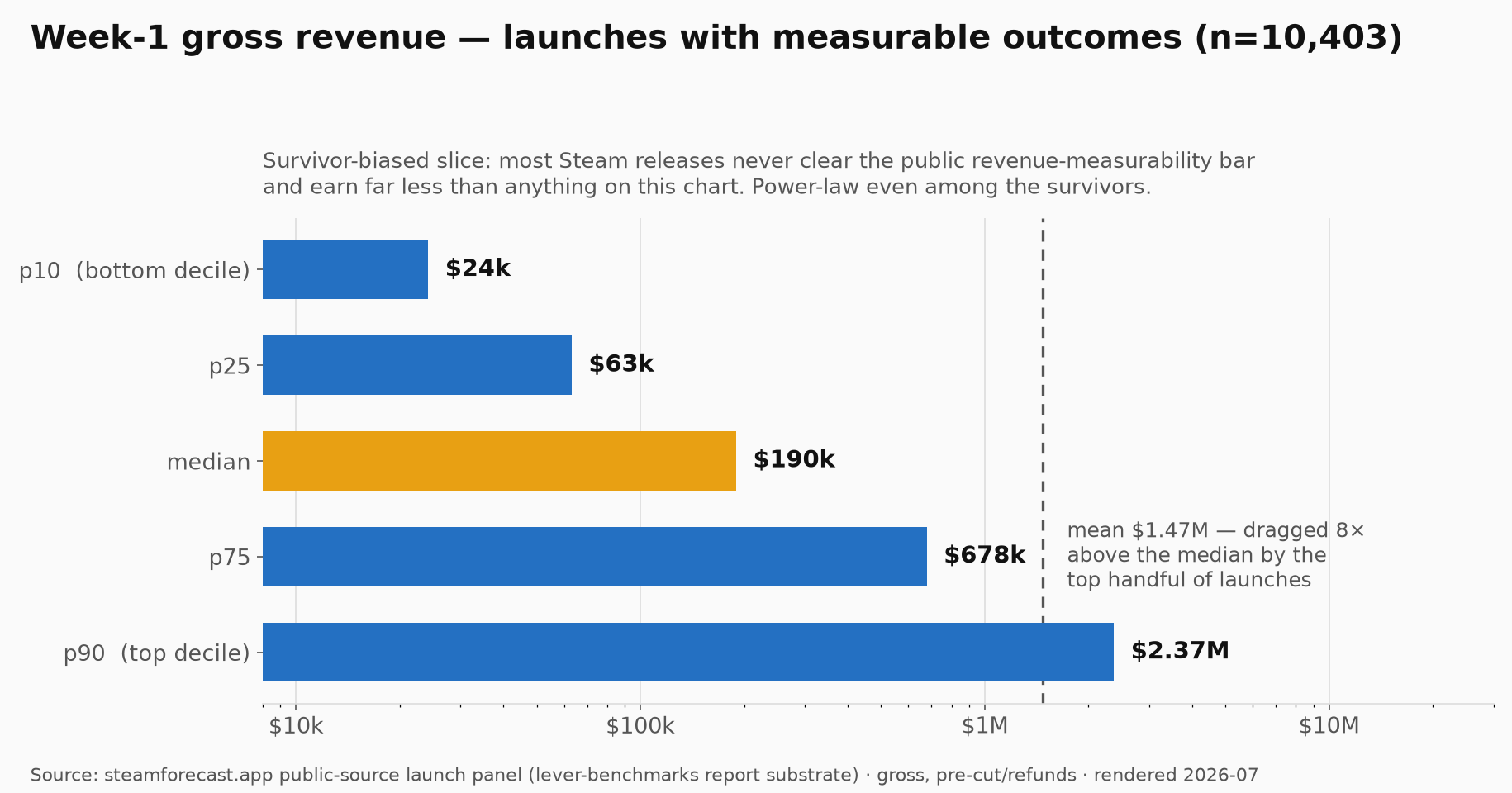
The power-law doesn’t stop at the discoverability floor; it keeps going inside the successful slice. Below is the week-1 gross distribution across the 10,403 launches in our public-source panel (the same substrate as our lever-benchmarks report), launches that cleared a revenue-measurability bar, i.e. already survivors. Even here the mean sits 8× above the median.
The number that matters is yours, not the catalog’s
A power-law median tells you what a random game earns. It tells you almost nothing about your game, because your wishlist trajectory, genre, price, and comp set place you somewhere specific in that distribution, not at the median by default. The whole point of forecasting is to find where on the curve you sit.
Run a free calibrated forecast on any released or unreleased Steam game and get a P10/P50/P90 revenue cone with 5 nearest-neighbor comp launches: the catalog average replaced with your game’s actual position.
Averages can’t plan your launch
Catalog averages, mean or median, describe a population. They’re fine for a journalist’s headline and useless for a founder’s budget. The power-law shape guarantees that any single summary number is wrong for almost every individual game: most titles fall well below the mean, and the median understates the games that did the homework on wishlists and positioning.
Plan against a calibrated forecast of your game instead, and budget against the downside (P10) of that forecast, not the median. A median estimate is right about half the time and badly wrong the other half; the P10 floor is the number you could still survive if everything went sideways. For why single-number heuristics fail and what a probability cone replaces them with, see the Steam launch revenue estimator walk-through.
Forecast your game, not the catalog average
Free single-game forecast on any released or unreleased Steam game. Calibrated cone (P10/P50/P90) + Boxleiter cross-check + 5 nearest-neighbor comp launches with revenue and wishlist trajectory.
Free forecast →Want the full launch report? $299 single launch report bundles the cone + Total Lift Attribution + marketing-lever causal estimates.
Frequently asked questions
How much does the average Steam game make?
The “average” (mean) is misleading because Steam revenue follows a power-law distribution: a small top fraction of titles captures the majority of total catalog revenue, which drags the mean far above what a typical game earns. The median is the right number, and public Steam catalog analyses (VG Insights, Game Discover Co) consistently find median lifetime GROSS revenue for a launched game sits in the low single-digit thousands of dollars, with a large share of titles never clearing a few thousand dollars in their lifetime. Figures vary by year and methodology. Forecast your specific game instead →
Why is the median Steam revenue so much lower than the average?
Because the distribution is Pareto-shaped. The top ~1-5% of titles capture the majority of all catalog revenue, so the mean is pulled up by a handful of breakout hits while most games cluster near the bottom. The median, the middle game, is unaffected by those outliers, so it reflects the typical outcome far better. Quoting the mean makes the “average” Steam game look several times more successful than the median game actually is.
How much of Steam revenue does the developer actually keep?
Well under the gross headline. Steam takes 30% of gross on most sales (the cut steps down to 25% above $10M and 20% above $50M in lifetime gross, thresholds most indies never reach). After Valve’s cut, take-home is further reduced by refunds, regional pricing, launch and seasonal discounts, VAT/sales tax, and any publisher or revenue-share splits. A useful planning rule is to treat developer net as a fraction of the gross headline, not the headline itself. See what a wishlist is really worth →
What wishlist count correlates with making real money on Steam?
Roughly: below ~7,000 wishlists most launches stay in the low-thousands “portfolio build” band; ~7K-50K is where “ramen-profitable” to “sustainable studio” outcomes cluster; 100,000+ is breakthrough territory. These are correlations, not guarantees; genre, price, and wishlist velocity shift the bands substantially. See the wishlist-threshold guide for the tier detail →
Can I use the average Steam revenue to plan my game’s budget?
No. Catalog averages describe a population, not your title, and the power-law shape means any single summary number is wrong for almost every individual game. Plan against a calibrated forecast for your specific game, ideally the downside (P10) of a probability cone built from comparable launches, rather than a catalog mean or median. That is the difference between budgeting against a number that is right 50% of the time and one you could still survive if things went sideways. See methodology →
Steam Launch Forecaster. “How Much Do Steam Games Make? The Real Revenue Distribution.” Updated 2026-09-07. https://steamforecast.app/guides/how-much-do-steam-games-make
- Sample
- n=10,403 Steam launches with measurable week-1 outcomes. Percentiles are of week-1 GROSS revenue, before Steam’s cut, refunds and tax.
- Sources
- the Steam Launch Lever Panel — 2026 (10,403 launches × 19 columns, built from public Steam sources only); GameDiscoverCo; VG Insights.
- Licence
- The 10,403-launch panel is published under CC BY 4.0 — reuse the numbers freely with attribution. The 77K-app calibration corpus is not redistributable.
- DOI
- https://doi.org/10.5281/zenodo.21478421
Corrections and questions: support. Numbers on this page are refreshed when the underlying data is; the date above is the last change to the page’s visible text.
Built by Greg C., senior software engineer with production ML experience in calibrated prediction. Steam Launch Forecaster trains a CQR-calibrated model on a 77K-app Steam corpus. See the methodology →