What actually moves Steam launch revenue?
Published 2026-07-01 · Causal-forest estimates over 10,403 launches · Cite this research
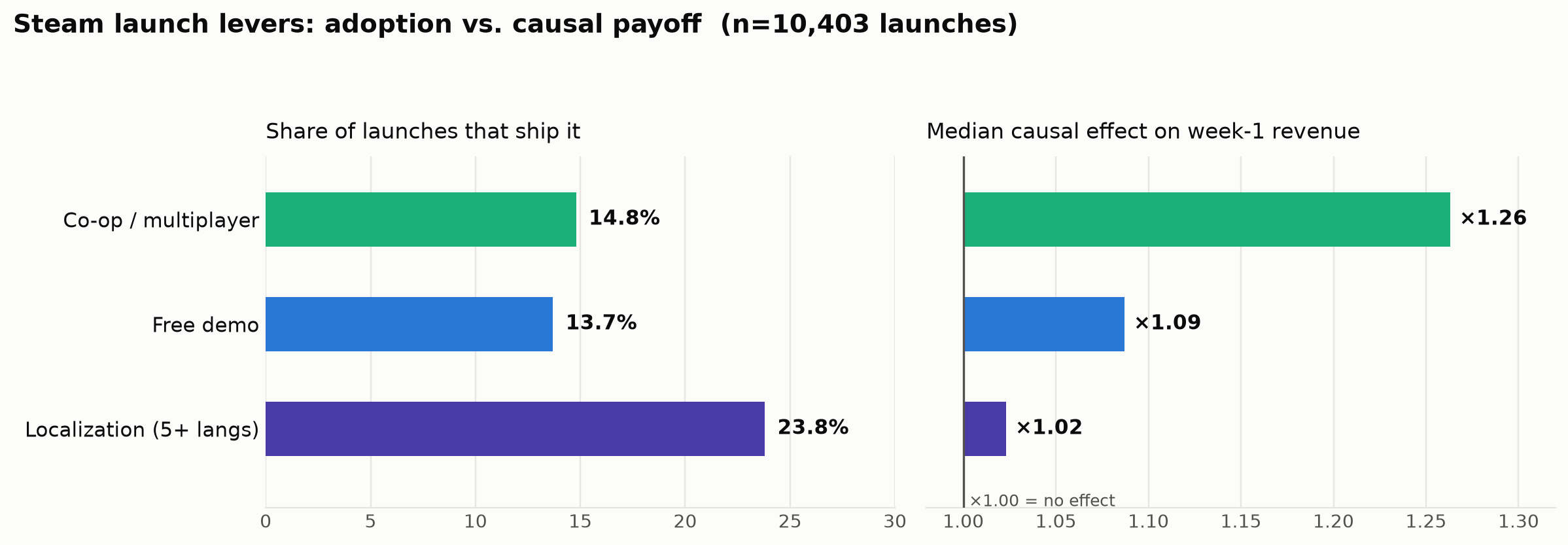
Most "what should I build before launch" advice is correlation dressed up as strategy. We ran Wager-Athey causal forests, a way to ask "what would this game's week-1 revenue have been with the feature vs. without", over 10,403 Steam launches. Three findings survived:
- Multiplayer/co-op is the most undersupplied revenue lever on Steam. Median causal effect: ×1.26 on week-1 revenue, positive for 95% of launches, yet only 14.8% of launches ship it.
- Demos help most games, modestly. Median ×1.09, positive for 75%; a quarter of games see no benefit.
- Localization is the overrated lever for week-1 revenue: median ×1.02, positive for just 57% of launches, statistically a coin flip.
Why "causal" is the load-bearing word
Games with multiplayer earn more for boring reasons too: bigger teams, bigger marketing budgets, genres with bigger audiences. A raw comparison inherits all of that. Causal forests estimate the conditional average treatment effect: the expected revenue difference for a game with your follower count, genre cluster, and tag profile. Each estimate carries a 95% confidence interval from the influence function, the same estimates that power the what-if levers in our forecaster.
This distinction is why the numbers below disagree with most "top games with demos earn 3× more" posts. Those posts are describing the population of games that ship demos (which skews toward teams with the budget and discipline to build one), not the effect of the demo itself. Strip the confounders out and the effects are smaller, but they hold.
Lever 1: Co-op/multiplayer, the biggest effect, shipped by the fewest games
Only 14.8% of the 10,403 launches in the panel ship co-op or multiplayer (the lowest adoption of the three levers), yet it carries the largest causal effect by a wide margin: a median ×1.26 on week-1 revenue, with a positive estimated effect for 95.4% of launches. That combination, biggest payoff and fewest adopters, is what makes it the most undersupplied revenue lever on Steam.
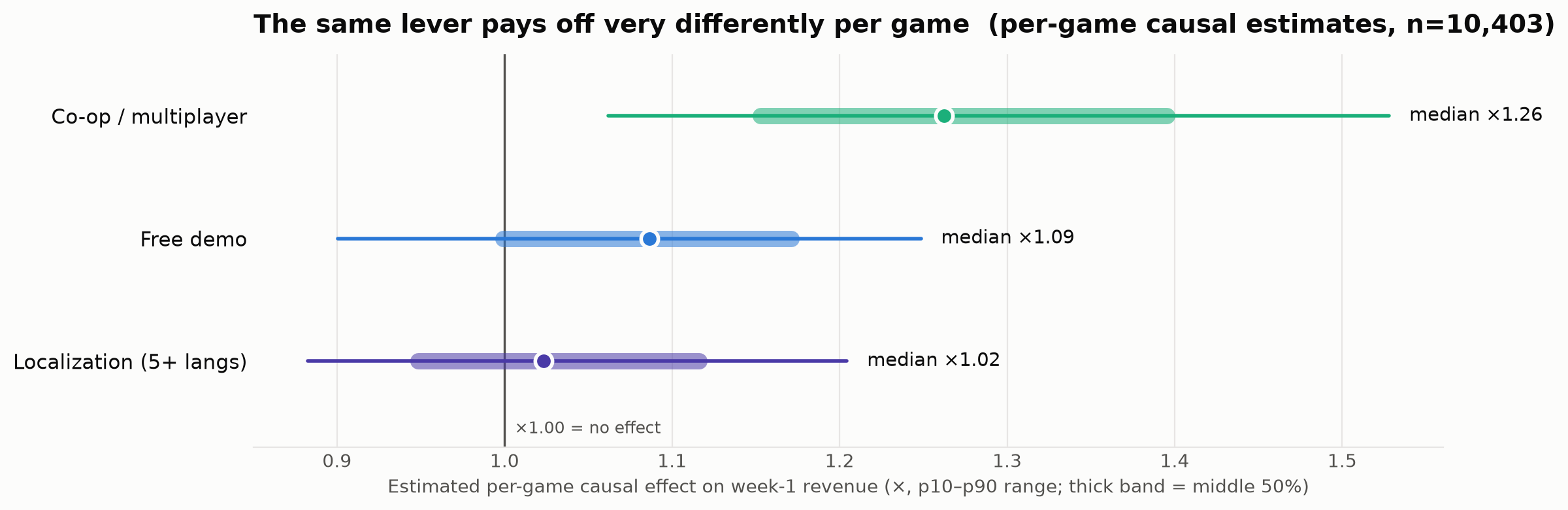
The per-game spread runs from roughly ×1.06 at the 10th percentile to ×1.53 at the 90th, with the middle half of games between ×1.15 and ×1.40. Read that carefully: even the games at the bottom of the multiplayer distribution have a positive estimated effect. Almost no other pre-launch decision we can measure has that property. The caveat is equally important: multiplayer is the most expensive lever on this list to build, often by engineering-years, and nothing here prices the cost side. If your game concept can carry co-op without breaking its design, the revenue side of the ledger is unambiguous; whether the cost side balances is a per-studio question.
Lever 2: The free demo, helpful for most, a wash for a quarter
Demos are shipped by 13.7% of launches and carry a median causal effect of ×1.09 on week-1 revenue, positive for 74.8% of launches. That is a real, useful effect, but it is far from the universal "always ship a demo" rule the advice ecosystem has settled on.
The distribution is the real story: the per-game estimate spans ×0.90 to ×1.25 (p10–p90), and the 25th-percentile game sits at almost exactly ×1.00, no effect at all. A quarter of games get nothing (or slightly worse than nothing) from a demo in week-1 terms. The mechanism is intuitive: a demo converts curiosity into confidence for games whose appeal survives a hands-on slice, and it burns novelty for games whose hook is thin or whose first hour is unrepresentative. Which side your game falls on is exactly the kind of question a per-game estimate answers and a population average cannot.
Lever 3: Localization, the most-shipped lever and the weakest
Localization into 5+ languages is the most adopted lever in the panel (23.8% of launches ship it, more than demos and multiplayer) and it has the smallest week-1 effect: a median of ×1.02, positive for only 57.4% of launches. Statistically, that is close to a coin flip. The per-game spread (×0.88 to ×1.20, with the middle half between ×0.95 and ×1.12) straddles the no-effect line.
Two things keep this from being an anti-localization argument. First, the estimate covers week-1 revenue only; localization plausibly earns its keep in the long tail and through regional pricing, which are outside this panel. Second, for some genres and some target markets the per-game estimate is solidly positive; the median is not the message for those games. What the number does say: if you are resource-constrained pre-launch and treating "translate the game" as a default revenue move for launch week, the causal evidence is weaker than its popularity suggests.
The same lever is not the same bet for every game
The median hides the spread. Per-game estimated effects vary widely: a demo is a clear win for some profiles and a wash for others. If someone sells you a flat "demos add X%", they are averaging over games that are not yours.
The numbers
| Lever | Ships with it | Median causal effect (week-1) | Positive for | Per-game range (p10–p90) |
|---|---|---|---|---|
| Co-op / multiplayer | 14.8% | ×1.26 | 95.4% of launches | ×1.06 – ×1.53 |
| Free demo | 13.7% | ×1.09 | 74.8% | ×0.90 – ×1.25 |
| Localization (5+ languages) | 23.8% | ×1.02 | 57.4% | ×0.88 – ×1.20 |
Median = median per-game conditional causal effect on week-1 gross revenue. Per-game range = 10th–90th percentile of the per-game estimates. On the mean instead of the median, the ordering is unchanged (multiplayer ≈×1.27, demo ≈×1.07, localization ≈×1.02).
How to read these numbers for your game
- If you are pre-production: the multiplayer number is the one worth sitting with. It is the only lever here whose estimated effect is positive for nearly every profile of game, but it must be a design decision, not a bolt-on, because the estimate does not price the build cost.
- If you are 3–6 months out: the demo decision deserves a per-game answer, not the population median. A quarter of games get nothing from it; whether yours is in that quarter depends on genre, tag profile, and audience size, the covariates the forest conditions on.
- If you are allocating a fixed pre-launch budget: week-1 causal evidence says localization ranks behind the other two levers, despite being the most commonly shipped. Treat it as a long-tail investment, not a launch-week one.
- If someone quotes you a flat multiplier ("demos add X%"), ask which games it was averaged over. The per-game ranges above are wide enough that the population answer and your answer can point in opposite directions.
Method, in plain terms
We fit one Wager-Athey causal forest (econml) per treatment (shipped a free demo, shipped co-op/multiplayer, shipped 5+ languages) over public-storefront covariates: follower count, recommendations, genre cluster, and tag profile. The forest's job is to compare each launch against counterfactual launches that look like it on every observed dimension except the treatment, which is what turns "games with demos earn more" into "this game would likely have earned more with a demo." Every per-game estimate carries a 95% confidence interval from the influence function.
Outcomes are review-count-derived week-1 gross revenue estimates, the standard Boxleiter-class approach, described in full on our methodology page. We report medians rather than means throughout because per-game effects are skewed; the means tell the same story. The panel is public-source only: no licensed market data enters these estimates.
What this does and does not say
- Population: 10,403 launches with measurable revenue outcomes, a survivorship-biased subset of all Steam releases. Multiplicative effects are the robust story; absolute dollar figures from this panel would overstate the typical release.
- Outcomes are review-count-derived revenue estimates (the standard Boxleiter-class approach), not disclosed sales.
- Week-1 revenue only. Localization plausibly earns its keep in the long tail and via regional pricing; that is outside this estimate.
- Effects are conditional. "Add multiplayer" costs engineering-years for some games. The estimate prices the revenue side only, and the per-game spread (chart 2) is exactly why we ship per-game estimates in the forecaster rather than one number for everyone.
Frequently asked questions
Is a Steam demo worth it for launch revenue?
For most games, yes, modestly: the median causal effect of shipping a free demo is ×1.09 on week-1 revenue, and the estimated effect is positive for about 75% of launches. But the spread matters: for roughly a quarter of games the estimated effect is zero or negative, so it is not a universal rule.
Does localization increase Steam launch sales?
Less than the conventional advice suggests, for week-1 revenue specifically: the median causal effect of shipping 5+ languages is ×1.02, and only 57% of launches have a positive estimated effect, statistically close to a coin flip. Long-tail and regional-pricing effects are out of scope of this estimate.
What is the most impactful feature for Steam launch revenue?
Among the three levers we can estimate causally, co-op/multiplayer: median ×1.26 on week-1 revenue with a positive estimated effect for 95% of launches, yet only about 15% of launches ship it, making it the most undersupplied lever on Steam. The estimate is conditional on genre and audience-size confounders, and building multiplayer has real costs the estimate does not price in.
How were these effects estimated?
With Wager-Athey causal forests (econml), one forest per treatment, over public-storefront covariates (followers, recommendations, genre cluster, tag profile) on 10,403 Steam launches with measurable revenue outcomes. Each per-game estimate carries a 95% confidence interval from the influence function. Outcomes are review-count-derived, so the panel is a survivorship-biased subset of all releases; multiplicative effects, not absolute dollars, are the robust story.
The full panel behind this report is published openly as Steam Launch Lever Panel — 2026 — 10,403 launches × 19 columns, CC BY 4.0. Built from public Steam sources only; no licensed third-party data, no wishlist columns.
- DOI
-
https://doi.org/10.5281/zenodo.21478421
(Zenodo — always the latest version; cite this one)
https://doi.org/10.5281/zenodo.21478422 (Zenodo — pins v1, for exact reproducibility)
https://doi.org/10.17605/OSF.IO/NBYQX (OSF)
https://doi.org/10.17632/gyvf8m8pgk (Mendeley Data) - Download
- CSV · Parquet
- Mirrors
- Zenodo · OSF · GitHub · Hugging Face · Kaggle · DataHub · Mendeley Data
Steam Launch Forecaster (2026). What Actually Moves Steam Launch Revenue? Causal Benchmarks From 10,403 Launches. https://steamforecast.app/reports/steam-launch-lever-benchmarks
BibTeX
@dataset{steamforecast_lever_panel_2026,
  author    = {{Steam Launch Forecaster}},
  title     = {Steam Launch Lever Panel --- 2026},
  year      = {2026},
  publisher = {Zenodo},
  doi       = {10.5281/zenodo.21478421},
  url       = {https://doi.org/10.5281/zenodo.21478421},
  note      = {Concept DOI --- always resolves to the latest version},
  license   = {CC-BY-4.0}
}
Please carry this caveat. Revenue is derived from review counts (a Boxleiter-style proxy), so the panel is a survivorship-biased subset of all Steam releases: games with too few reviews to estimate are absent entirely. Multiplicative effects are the robust story; absolute dollar figures are not. Questions or a custom cut: [email protected].
Want these estimates for your game? The free forecaster runs a calibrated P10–P90 revenue cone on any Steam app ID (better-than-4-in-5 realized coverage, n=6,422 held-out launches). The $299 launch report adds the wishlist-aware cone and every per-game what-if lever with confidence intervals.
Method: Wager-Athey causal forests (econml) per treatment (T_has_demo, T_supports_coop, T_languages_high) over public-storefront covariates (followers, recommendations, genre cluster, tag counts); 95% CIs via the influence function. Full modeling approach: /methodology. Related: how much Steam games make · wishlist benchmarks reality check.